

Those of us that ride horseback largely take our saddles and component parts for granted. Recently I wondered about the development of the stirrup. While I realized stirrups allow me to get on and off with relative ease and to retain my balance as my horse moves, I was surprised at the importance historians give to their development.
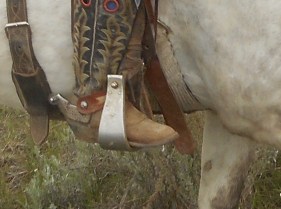
Historians argue over the stirrup’s relative importance, with some insisting that stirrups changed the course of history. That seems a tall order for our little foot holder.
Historically, though, before we needed stirrups, we needed horses. Dan Derby in How the Stirrup Changed Our World wrote that historians believe horses had been domesticated as a food source by 6000 BC, but riding wasn’t practiced until 4000 BC in the Eurasian steppes, probably around Kazakhstan. Remember Ghengis Khan?.
Then, before riding became much more than an adventure, some method had to be developed for steering – enter the bitless bridle then later the bridle. Now we’re getting somewhere!
Riding reduced travel time from a few days to a few hours, increasing the possibility for trade, far reaching warfare and adding a new weapon – high speed retreat. It also enabled settlement of remote and inhospitable areas because it allowed for the widespread search for food.
In warfare, horses were first used to get troops to the battle lines where soldiers then dismounted and fought hand to hand. Dismounting to fight seems odd at first blush, but think about fighting bareback carrying a sword or lance. Try it out (with safety in mind, of course) by riding bareback while wielding a light pole. Swinging the pole unbalances you so you drop the pole or fall off your horse. With a horse’s rounded back, leg strength alone can’t counterbalance a weight extended from the arm.
Back to historical progress, the first saddles were developed around 700 BC according to a web source at .https://ancientpeoples.tumblr.com/post/29549387655/the-history-of-the-horse-tack-in-ancient-terms. Early saddles were little more than animal hides with a strap to hold them on but rapidly changed to two parallel cushions with a frame. It wasn’t long before a solid tree evolved, which benefited the horse more than the rider by protecting the horse’s sensitive back.
Now that we finally have the saddle, it’s time for the development of the stirrup. Archaeologists have found saddles with a leather strap hanging on one side and historians suggest that the strap was a loop used for mounting. Soon leather straps were added on both sides, then straps with a small loop for a single toe.
The thought of riding with that saddle makes my toe ache, but for stability it was a major improvement over just gripping with the leg. It didn’t take long, though, for the leather straps with a toe loop to evolve to full support for the foot. According to Dr. Lynn White, Jr. in his book Medieval Technology and Social Change full stirrups were popular in China by AD 415, and they were in wide use by AD 732 according to John H.,Lienhard at www.kuhf.org/programaudio/engines/eng476_64k.m3u.
Dan Derby in writing about the impact of technology on society quoted modern Chinese historian Gu Zhun who said. “stirrups immediately made hand-to-hand combat possible, and this was a revolutionary new mode of combat…very seldom had there been an invention as simple as the stirrup, but very seldom did it play the kind of catalytic role in history that this did.”
Dr. White insists that the feudal system and city states developed because of a charging cavalry’s ability to transfer a horse’s mass and speed to the tip of a lance, and that ability was possible because of the stirrup. While other historians disagree on it’s relative importance, all agree that the stirrup was critical in the development of mounted warfare.
Mounted warfare in turn led to Europeans overpowering warriors from the steppes. Derby summarized that “Success in those forms of warfare changed who ruled and who perished. The languages we speak, the food on our table, the system of government we use and even our genetic makeup were affected…It changed our world.”
It turns out that my belief that stirrups just simplified mounting, balancing and dismounting was a short sighted view – what a significant impact they’ve had on our entire history.
 Sandy Snider Stahl