
A Calf Joins Our Family
In ranching, as in most businesses, every day is the same, yet every day is different. We’ve had several calves get into water tanks over the years, and a few have even drowned. So on July 20, 2022, it wasn’t that unusual to find a steer calf stranded in a water tank, but what was unusual was the impact he would have on our lives.
The calf had obviously been in the tank for hours – we check the water every couple days so it could have been over a day, we just don’t know – but he hadn’t been able to jump out. With Sonny at 87 and me 70, and having long passed the peak of our physical strength, it took everything we had to get the calf out. He splashed and moved back and forth a little, but was pinned between the side of the tank and a plank designed to keep cattle from getting into the tank. We pushed, pulled, lifted, swore, puffed, then took a break for thought. I got into the tank and pushed, pulled, slipped, and lifted from inside – we no longer had air for swearing – while Sonny did the same from outside and we finally flipped him out. He was exhausted from standing for so long that once he was on dry ground he didn’t even try to get up. We all took a few minutes to gather our breath, then we pulled him away from the tank so the cattle coming in to drink wouldn’t step on him. We gave him a little feed and left him overnight, hoping he’d get up, find Mom, suck and move on. That didn’t happen.
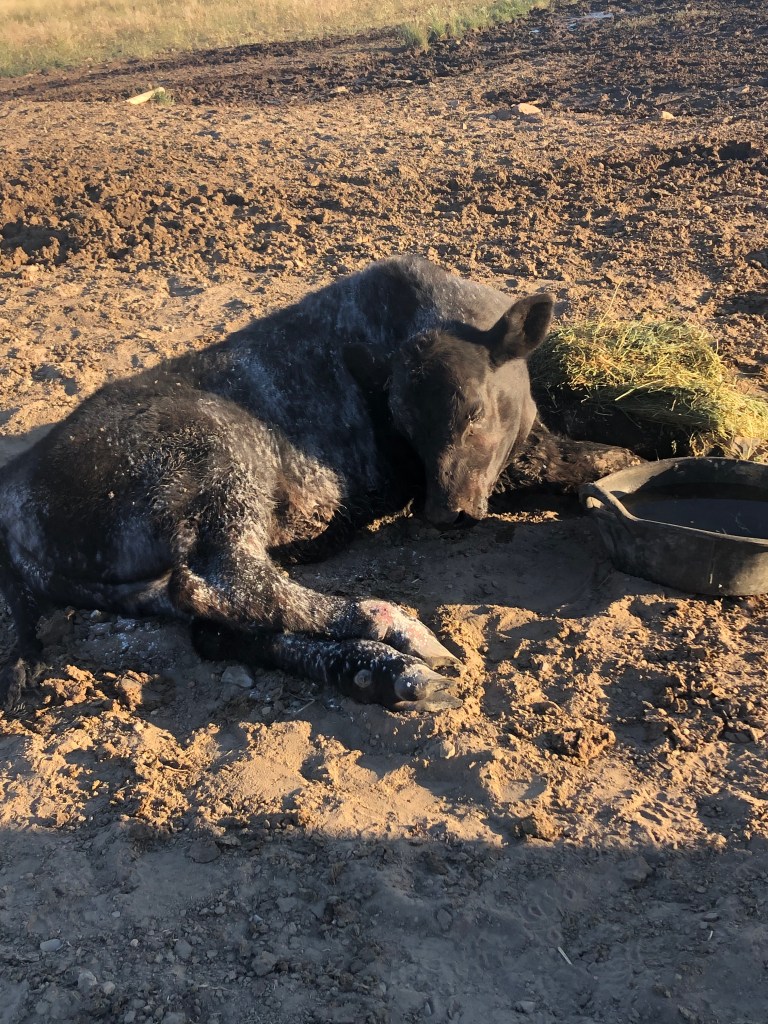
Born in March, the calf weighed about 250 pounds and was one of the bigger steer calves at the time. He hadn’t gotten up by the next morning but he’d pulled himself around a bit, so we put portable corral panels around him to protect his feed and water from other cattle and tied tarps around and over the panels for shade. He ate and drank, and after 5 days he did, finally, get up. His mother may have come around when we weren’t there at first, but we never saw a cow that acted like his mother. He was old enough by then that he didn’t have to have milk and he eagerly ate his hay and grain.
Once we knew he could walk, we loaded him into a horse trailer and hauled him home. He walked into the shed under his own power but spent nearly all his time lying down for the first several weeks. His appetite was always good, but he lost weight at first. His food and water were only a few feet away so he would eat and drink then he’d immediately go back to his bed of straw.
The hide on his legs felt hard from the moment we rescued him, and started flaking off the back of his front knees within a few days. We talked to Dr. Abbie Schoonover of the Broadus Vet Clinic when we realized how hard his leg hide was, and have followed her advice throughout. She explained that essentially, his hide was “burned” from being in water for so long. (Abbie is a friend as well as our vet, so I informally use her first name, fully respecting her title as Dr.) As Abbie suggested, I oiled his legs where the hide flaked off, which was only on the backs of his front legs above the knee, then bandaged the larger areas as needed. Nearly all the hide on his back legs and the lower front legs came off in large chunks. The hide on the left front leg remained an intact tube that I finally cut apart to remove. When the hide was in the shedding process, we used it as a self bandage when appropriate.
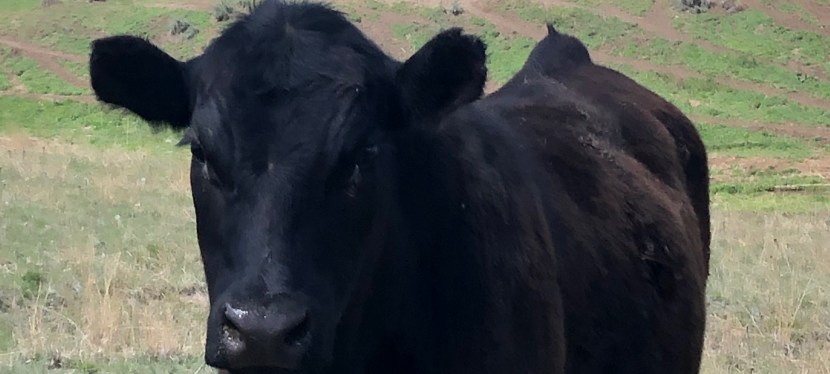
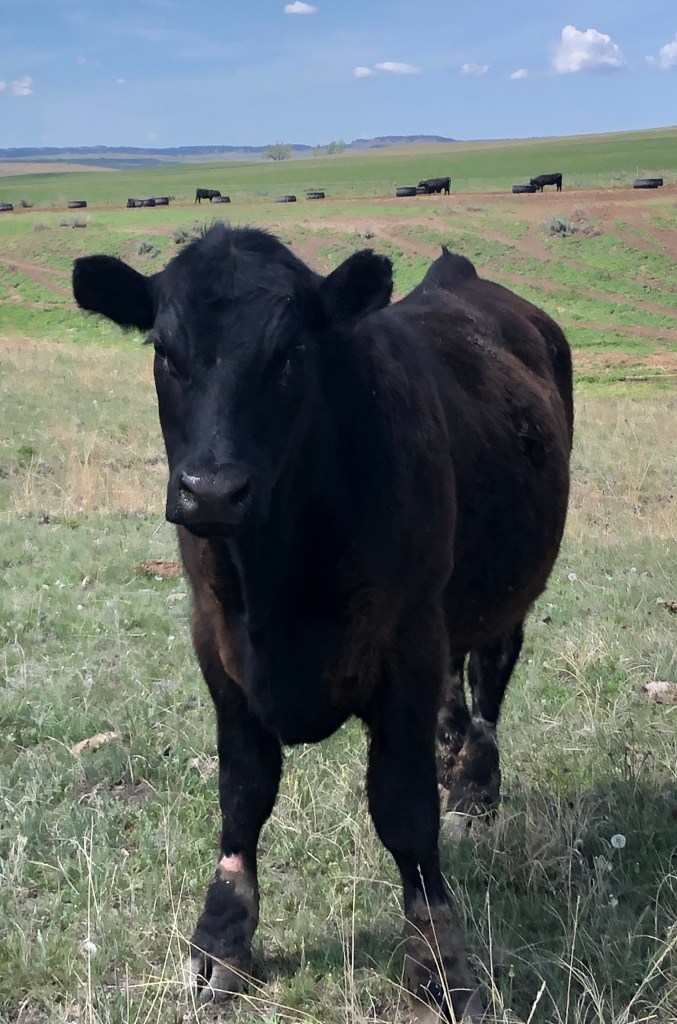
Right away this calf and I developed a strong bond and I changed his name from “The Calf” to that of a warrior associated with water, or more accurately, lightning and thunder – Thor. The name suits him as he has been a warrior, and even people who know only a little of his story easily remember his name and their first question when they see me is often, “How is Thor?”
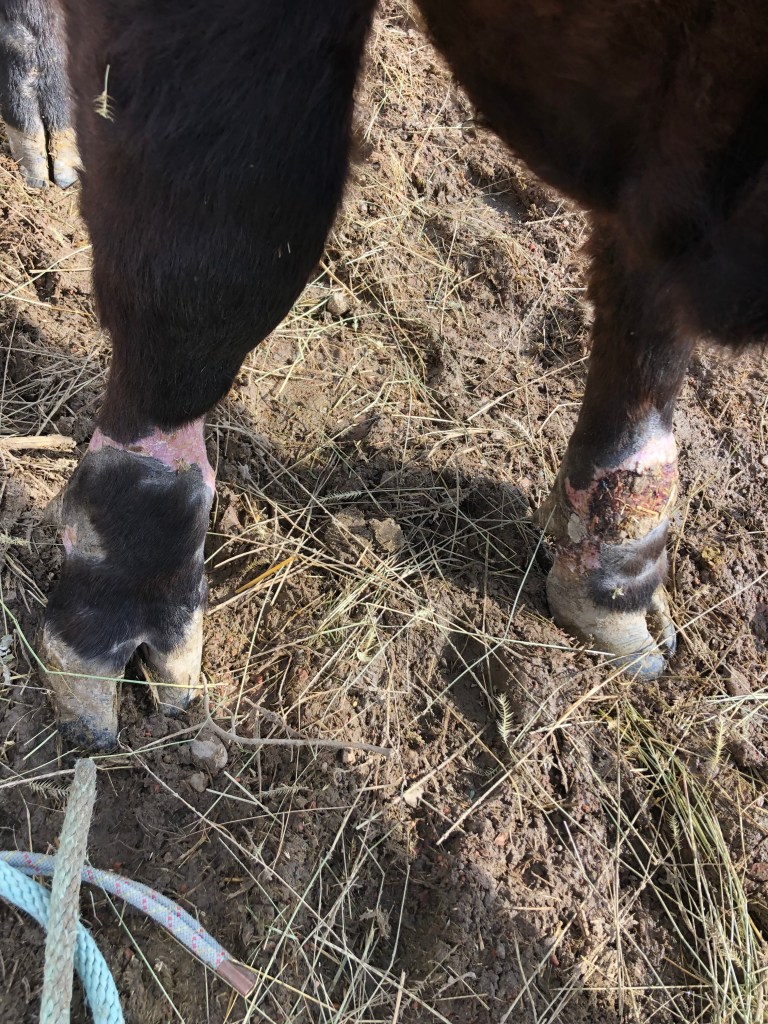
Eventually, the open areas on the back legs extended from several inches above the hock to the hoof on both legs, except that the hide and hair remained intact on the back of both hocks and in a few places on the backs of the legs. Similarly, the hide on the front of the right front all came off but a strip remained intact on the back of the leg. All the hide on the left front leg came off from the hooves to midway between the knee and ankle in a tube, as I mentioned before. An outer layer of one dewclaw came off, but the hooves remained solid and not visibly damaged.
Thor’s left front ankle and knee were swollen, the ankle remains enlarged and the healing has been slower over that ankle. His left front leg caught between the plank and the water tank as we got him out, and we wonder if that caused additional problems that slowed the healing on that leg. It was also closest to the water source, the coldest water in the tank. However, he was never actually lame or favored any leg.
Abbie prescribed a pain/anti-inflammatory medication in the early days of bandaging. Thor got his pill twice a week and I coordinated one with bandaging, giving it 12 to 24 hours in advance. Even by the third month, Thor’s behavior told me when he needed a pill as it was much more difficult for him to get up and he moved slower. Early on, we gave them every 2 1/2 days, by which time he was grinding his teeth and lying out flat rather than upright with his legs tucked under him. But as with humans, we tried to minimize his pain but not overdose him with pain meds. By the third month when I started writing this, Thor took 2 pills per week at 3 1/2 day intervals. and no longer ground his teeth.
At the first total re-bandaging, I did all four legs one day, which proved to be too much for both Thor and myself. Until approximately the third month, I did only 2 legs on a given day and toward the end of this period, I had to wait for Thor to lie down with the correct side up as he had grown too big for me to lift and hold the lower back leg as I bandaged. In the early days, standing during the process was a painful experience for him and really difficult for me. Later on we became accustomed to our routine and I could quite easily re-bandage with him standing. Additionally, I didn’t have to wrap clear to the hoof by then so it didn’t matter if he was standing in bedding. It always helped to have someone near his head to scratch and keep him from walking off. Scratching kept his mind off what I was doing and gave him something else to think about – and enjoy.
I used the following supplies for bandaging – kitchen shears, old towels, tarp, bucket of cold water and sponge, Vetricyn spray, vaseline, 3″ x 8″ Telfa pads, 3″ x 4″ Telfa pads, Vet wrap, Elasticon wrap, Gorilla Tape, and socks.
When Thor was lying down, I put a tarp under the appropriate leg and placed a rolled towel under the knee. The towel both lifted the leg a little and soaked up excess water so the new bandages stayed dry(er). Thor liked to eat his old bandages and drink the sponge water, so I tried to sit or squat between his head and the leg I was working on and toss old bandages out of reach. When he was smaller, I could push back on his shoulder if he wanted to get up. Later on, if he wanted to get up, he got up.
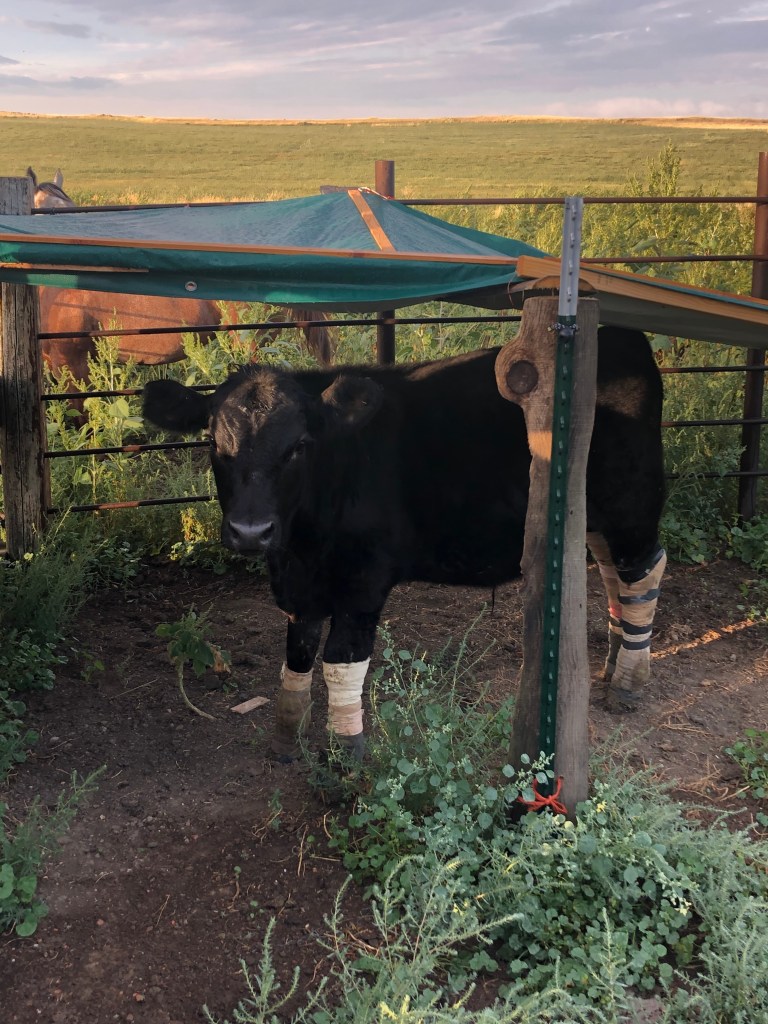
Perhaps this is where I can tell you about Thor himself rather than his injuries and recovery. From the first day that we pulled him out of the tank, he did not fight us. He was kind and gentle and seemed to know we were trying to help him. Thor never kicked at me even though I know he was in terrible pain at times. If you have ever had a burn that removed skin, you know what he went through once every week from above his hocks to his hooves on all four legs. Rather than trying to avoid being doctored, he simply accepted it.
There were only a few times that the pain was more than he could lie down and accept. I spent a few sleepless nights after those episodes figuring out what to do differently the next time. And we did get it down to a pretty good procedure for both of us. This whole process was pretty gruesome but Thor made it incredibly rewarding. I would hesitate to put another animal through it, but I would not have missed getting to know Thor. I have loved many animals – dogs, cats and horses, but he is probably the greatest animal friend of my life. He may not give the same loyalty to me that a dog does, but he has given me all that a calf can possibly give. I have received much more from him than I have given, and I gave him all that I had in me.
The day I started writing this for instance, as I worked on a front leg, he turned around and licked the top of my head. Then as I took a break after the first two legs and rubbed his shoulder and neck, he thoroughly licked my hands. Sometimes he just lays his head across my back and holds it there. Of course he likes to be scratched and groomed, but he gives affection as well as takes it.
Now for the bandaging process itself. I used shears to cut through the Gorilla tape (whose only purpose was to hold the ends of the Vet wrap or Elasticon in place), leaving the Telfa pads in place on his leg. Most of the time I only cut through a few inches of Vet wrap, uncovering a few inches of raw leg at a time. This was critical early on, but became less important later on. I kept sponging from the top with cold water as I removed one or two pads at a a time. I took a photo if possible, sprayed the area with Vetricyn then placed new Vaseline coated Telfa pads over the area, wrapped Vet wrap around to hold the pads in place. then proceeded down his leg a few inches at a time.
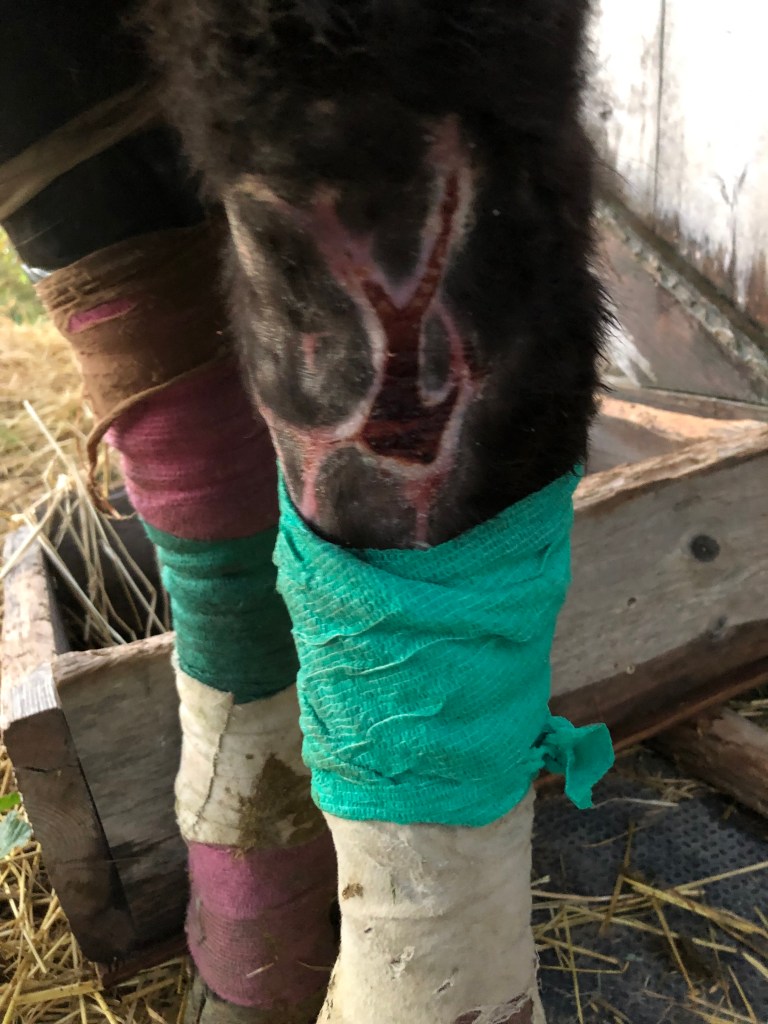
After the whole leg was re-covered, I wrapped the top, bottom of the bandaging and the end of the Vet wrap with Elasticon. I added a wrap of Gorilla tape over each of those places to secure the ends. I cut the toes off each sock and pulled one over each leg, then wrapped the top and bottom of the sock with Gorilla tape. If the sock ended at the top of the vet wrap, I only used Gorilla tape after the sock was on, if possible. I cut the socks in half for the front legs but used a long sock for the back legs. The socks kept Thor from licking things loose and helped keep flies off the bandages.
Thor even got so he cooperated in getting his socks on when he was standing up by letting me lift his leg until I got the sock over his toes. We went through all of our old socks then I started buying him new ones. We spent literally hundreds of dollars on bandaging materials but new socks were just over $1 per leg per week. With everything else we spent, that was minimal. I only tried to remove a sock so I could wash and reuse it one time. The savings was not worth the effort!
By the third month, Thor was too big for me to push back down if he wanted to get up, and his bottom hind leg was too heavy for me to hold up while I was re-bandaging. Even with someone helping hold his leg up, it became easier to bandage him when he was standing. For one thing, he was on his feet most of the time by now and rarely laid down with the correct side up. By then we had the process worked out and I was able to bandage all four legs in about an hour and a half.
From early on, I captioned each photo after re-bandaging as it quickly became evident that it was hard if not impossible to tell in a close up which leg it was. Which is not to say I might not have made a mistake in the notes. I emailed Abbie weekly updates, including photos. I remember once sending the email with legs identified, then following immediately with a note that where I had written right I meant left…since I was looking at the right leg I hadn’t yet redone.
During the worst of this process, while I was learning how to do this and horrified at what I was seeing, I emailed Abbie, not only to update her but also because I could talk to her about how awful this was, share all my doubts and emotional turmoil, show her the photos and know she could take them. A lot of people knew about Thor and asked how he was doing, but I thought the reality was often too gruesome so I shared only as much as I thought appropriate. Abbie was not only knowledgeable but was also supportive, understanding and the rock I leaned on.
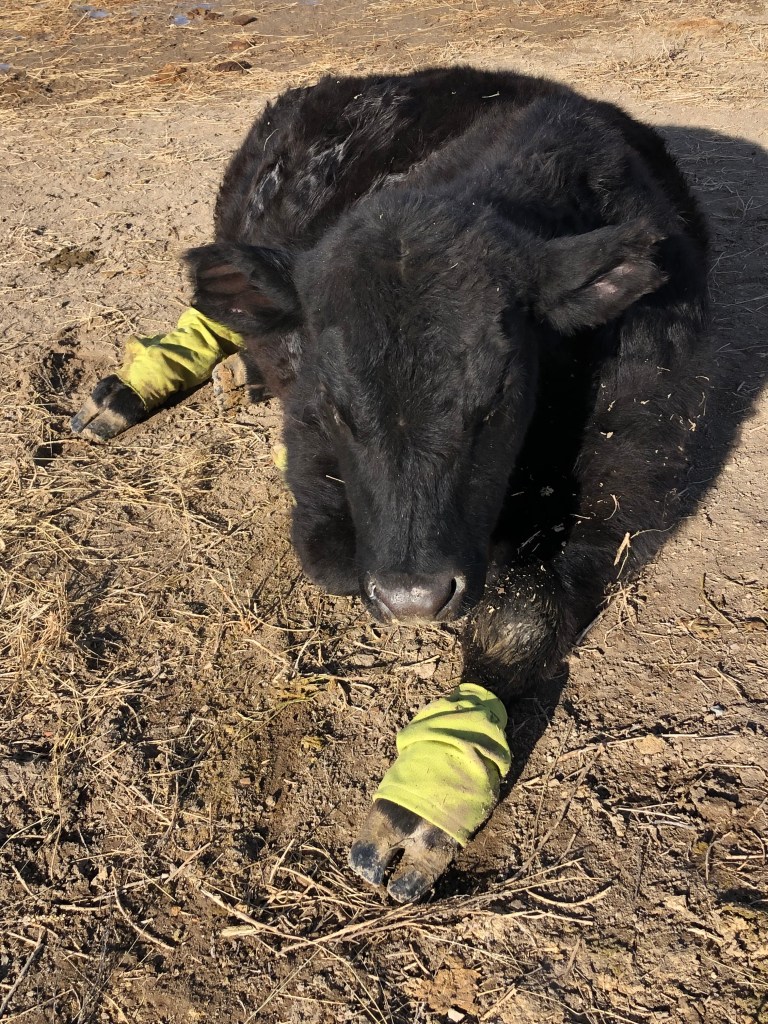
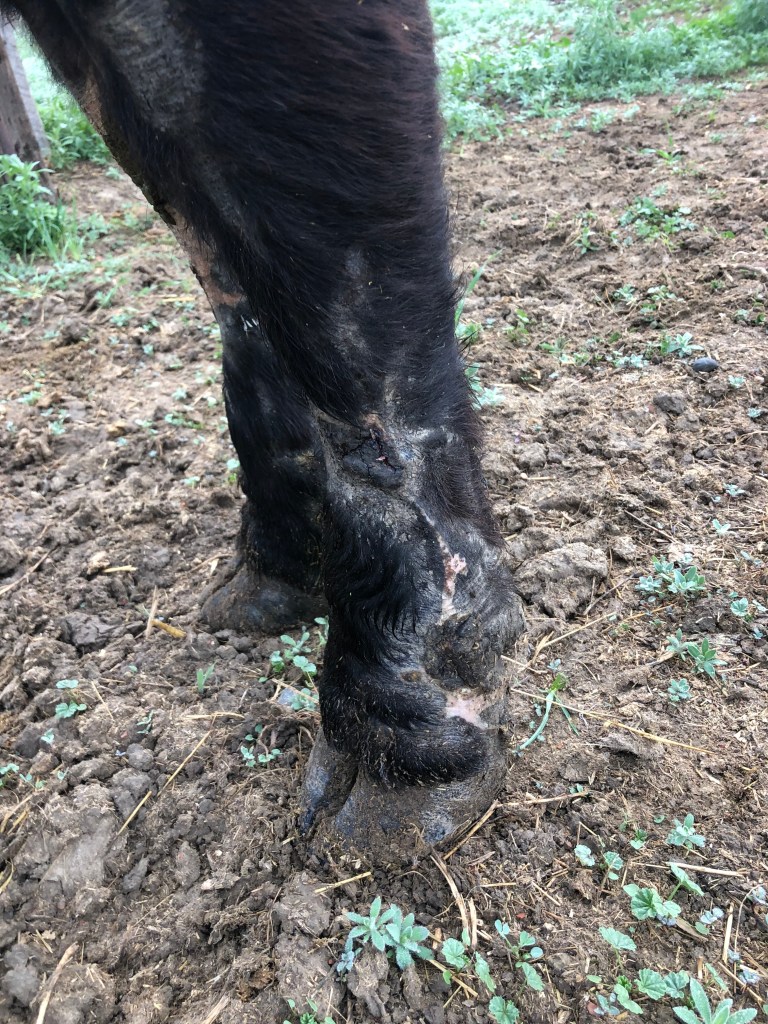
I started keeping a pictorial history so I could see the healing progression on each leg since the longer this went on the more the details blended in my mind. I think that much of it is too gruesome to share, but am including a couple videos and a few photos that show the extent of the bandaging and resulting scars. I can’t say a final photo because we aren’t done, though the last photo shows Thor with a lot of hair regrowth- but it doesn’t show his scabs. Last winter we kept him near the corral so he had a shed for protection from severe weather, and I made loose boots for every leg to keep his legs from getting too cold because then he still didn’t have much hair. Keeping his boots on and clean was another challenge! He even had an insulated set and a couple that weren’t insulated for cold but not bitterly cold weather.
However, this summer and winter we’ve progressed to the point that he has been out on pasture with the young cattle. I see him every day this winter (which I need much more than he does), and give him hugs and scratches, and frequently coat the scars and scabs with ointments to keep them soft. There are two small areas on his left front leg that are not healed yet, and some of the scars on each leg often scrape off and have to reheal. His joints are a little stiff, his front feet are a little enlarged and he’s a slow coach, by nature I think, as much as because of his legs. He bucks and runs a few steps sometimes, but mostly he just moseys around, grazing at his own pace. When we move the cattle, if he lags behind, that’s OK, he’ll follow or not as he wishes – he is not forced to do anything! He’s fat and we hope to the heavens that he’s happy.
I’m writing now over 18 months after we found Thor in the water tank. I don’t know that his left front leg will ever completely heal but one thing I do know is that Thor’s future is secure. He will have a home with Sonny and me for the rest of his natural life. We will help and protect him as best we can while letting him be a bovine living with his kind. In our hearts,Thor rules!
 Sandy Snider Stahl